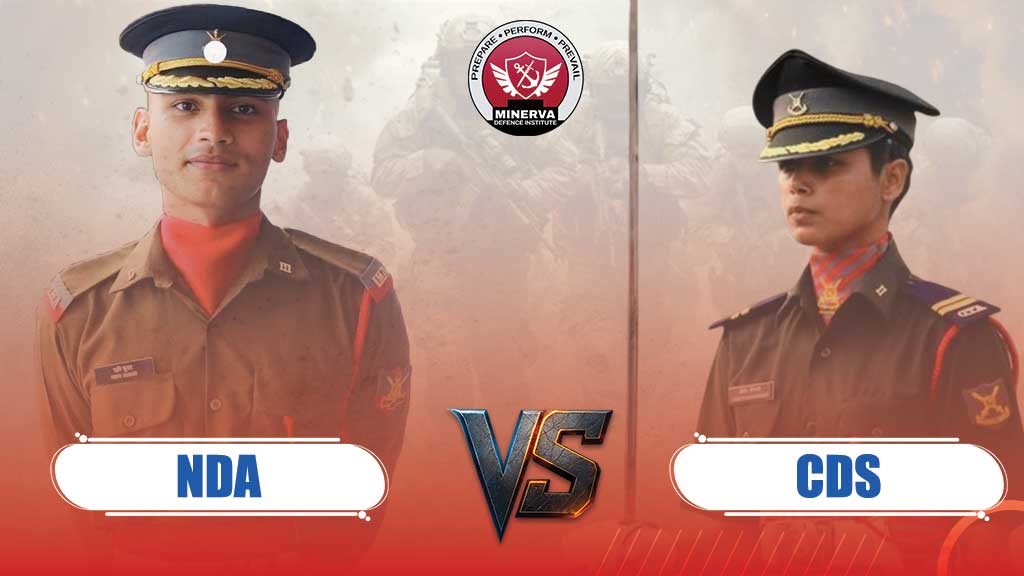
Choosing between NDA and CDS is one of the most difficult tasks for a defence aspirant, as both of these lead to high-ranking officer-level positions in the Indian Armed Forces, but both of these have different journeys making the NDA vs CDS comparison important. The real difference between NDA and CDS comes down to your education level, age limit, exam structure, and the exact stage of life when you are actually eligible to apply. NDA is built for students who are eager to join the defence forces right after finishing their 12th class, giving these young candidates a chance to jump into military training and grow leadership skills during their early academic years. On the flip side, CDS is made for graduates who decide to enter the armed forces after they have already finished their college degrees. A defence aspirant should understand the difference between these two, as their preparation, including NDA exam preparation & future career depends on it.
Eligibility and Educational Requirements
Before applying for any of these exams, a candidate should understand its eligibility criteria & educational requirements. As NDA and CDS have different educational requirements and age limits, which makes them suitable for different groups of students.
NDA Eligibility
The National Defence Academy exam is meant for students who have just completed school.
Key requirements include:
Candidates must have passed or be appearing in 10+2 from a recognized board.
For Air Force and Navy wings, Mathematics and Physics are compulsory subjects in class 12.
The age limit is usually between 16.5 and 19.5 years.
- Both male and female candidates can apply.
Since this exam is for younger candidates, the training period is longer and includes both academic and military learning.
CDS Eligibility
The Combined Defence Services exam is designed for graduates who want to become officers.
Main requirements include:
- Candidates must hold a graduate degree from a recognized university.
- For Air Force entry, candidates must have studied Physics and Mathematics earlier.
- The age limit generally falls between 20 and 24 years, depending on the academy.
This exam allows students to complete their college education before entering military training.
Age and Career Timing – NDA vs CDS
Another important difference between the two exams is the stage of life when candidates begin their defence career. This difference mainly comes from the education level required for each exam.
NDA Entry Timing
NDA is meant for students who have just completed their school education. Most of the candidates apply for this after class 12 and fall within the age range of 16.5 to 19.5 years. Because of this, they start their defence training at a younger age. After completing training and commissioning, NDA officers begin their careers earlier and have more years ahead in service.
CDS Entry Timing
CDS is designed for candidates who have already completed their graduation. Most of the applicants appearing for the CDS exam are either in their final year of college or have finished their degree. The age limit for CDS is around 20 to 24 years, depending on the academy.
Career Timeline Difference
Due to the difference at the entry stage, NDA officers start their professional journey much before the CDS ones, CDS officers enter the defence forces after gaining a college education. However, once both are commissioned as officers, their career path, responsibilities, and promotion system become almost the same.
Selection Process and Exam Pattern – NDA vs CDS
Both NDA & CDS exams follow a very optimized & structured selection system, which is designed to test knowledge, personality, leadership ability and physical fitness, making the NDA vs CDS comparison important for aspirants. However, the exam pattern and subject focus for both of these exams is slightly different.
NDA Selection Stages
The NDA selection process happens in two major steps.
Written Examination
The written test includes two papers:
- Mathematics
- General Ability Test – These papers check numerical ability, English skills, general awareness, and basic reasoning as per the NDA Syllabus.
Personality Assessment
Candidates who clear the written test move to the SSB interview, a multi-day evaluation where officers observe communication skills, leadership qualities, decision making ability, and teamwork and many candidates also prepare through the best SSB coaching in India.
CDS Selection Stages
The CDS exam also includes two main phases, but the written test is different.
Written Examination
The papers usually include:
English
General Knowledge
Elementary Mathematics
However, candidates applying for certain academies may not need to take the mathematics paper.
Officer Assessment
After clearing the written exam, candidates again go through personality testing and leadership tasks before final selection.
Psychological and Group Tests
During the personality evaluation stage, candidates take part in several activities such as:
- Group discussions
- Situation reaction tests
- Outdoor leadership tasks
- Personal interviews
These activities help assess whether the candidate has the mindset required for military leadership.
Training, Salary, and Career Path
Once candidates clear the selection stages, they move to training academies where they prepare for life as defence officers. The training style and duration vary between NDA and CDS entries.
Training Structure
Training plays a big role in shaping future officers.
NDA Training
Selected candidates join the academy in Pune for three years of combined academic and military training. During this period they study regular subjects along with physical training, discipline, and leadership exercises, building strong foundations and maintaining high dedication as part of their NDA exam motivation.
After completing the academy training, cadets move to their respective service academies for specialized training.
CDS Training
CDS candidates directly join the service academies such as the military or naval training institutes. The training duration is usually 12 to 18 months, depending on the service branch.
Since candidates are already graduates, the focus is mainly on military training rather than academic education.
Salary and Benefits – NDA vs CDS
Although officers from both entries eventually receive the same pay scale after commissioning, there are a few small differences in how the salary and benefits begin.
NDA Salary and Benefits
Candidates who clear the NDA exam join training soon after school. While the cadets are on their training period, they get a fixed monthly stipend of about ₹56,100/month. But as at this time the NDA cadets are still on their combined academic and military training, the stipend mainly covers their basic & personal expenses.
After that, when the training finishes and the cadets get commissioned, they start receiving the official defence pay scale, but the basic salary is just the starting point. The real value comes from the perks they get, such as free housing, travel offsets, full medical, and a solid pension plan later on. As you climb the ranks and pick up promotions, those numbers and benefits only get better.
CDS Salary and Benefits
CDS candidates start on the same official pay grade as any other officer. The trade-off is that their career starts a bit later in life compared to NDA officers, who get started right after school.
A newly commissioned CDS officer pulls a base salary of about ₹56,100, plus all the standard allowances. You’re looking at free housing, family healthcare, travel perks, and retirement security. The career path is the same as any other officer, as you move up in rank, the pay and the perks grow with you.
In simple terms, the pay structure for both entries becomes almost identical after commissioning, but NDA officers usually start their careers earlier
Dress Code and Discipline During Training – NDA vs CDS
Military life is built on discipline, and that starts with the basics like keeping your uniform and dress code on point. That said, the actual “vibe” and structure of the training isn’t exactly the same for everyone. Depending on whether you’re NDA or CDS, the daily environment and the way things are run will feel a bit different.
NDA Dress Code and Discipline
At NDA, cadets spend three years in a full-time training environment, where discipline becomes part of daily life. Cadets must follow strict uniform rules for almost every activity. This includes separate uniforms for:
- Parade and ceremonial drills
- Classroom lectures
- Physical training and sports
- Formal events and inspections
Since these guys are still finding their feet in the service, the academy really hammers home the fundamentals – discipline, punctuality, and looking the part—because keeping your gear in order is the first real test of whether you’ve got the backbone to actually be there. Keeping your uniform on point is a silent way of showing you can handle the responsibility and that you actually respect what the academy stands for.
CDS Dress Code and Discipline
Candidates entering through CDS join training academies after graduation. Because they are older and have already completed college education, the focus during training is more on professional military preparation rather than basic discipline building.
However, uniform rules are still strictly followed. Officers in training must wear proper dress during:
- Military drills
- Tactical exercises
- Classroom training
- Official ceremonies
Even though the training period is shorter than NDA, discipline and uniform standards remain equally important.
Career Growth After Commission
After completing training, officers begin their careers in different roles depending on their branch.
Common career paths include:
- Infantry or technical roles in the Army
- Naval operations and engineering branches
- Flying or ground duty roles in the Air Force
With experience and performance, officers can rise to higher leadership positions.
Which is Easier: NDA or CDS?
Students are always debating which exam is easier to clear, but honestly, both are a grind and “difficulty” really just depends on what subjects you’re good at. For most, the NDA feels like a bigger challenge early on because you’re jumping into it right after high school—a time when your grasp of advanced math and world news is often still catching up. On top of that, you’re stuck balancing the stress of your final board exams while trying to stick to a tough study routine for the military.
On the other hand, CDS is attempted after graduation, so candidates usually have more maturity and academic experience. Their reading ability, general awareness, and understanding of subjects are often stronger by that time. However, CDS is also competitive because candidates from many different academic backgrounds appear for it.
Preparation time also changes how hard things feel. Most NDA students start studying in class 11 or 12, but CDS candidates usually don’t even begin until they’re in or out of college. Both are tough because thousands of people try out for very few spots every year. At the end of the day, neither exam is really “easier” than the other. It all comes down to how well you study, how much you know the subjects, and if you can stay calm when the pressure is on.
If you want to join the military as early as possible, the NDA is the obvious way to go. But if you don’t decide until you’re already in college, then the CDS is your best bet. Either way, the only way to win is to stay consistent with your books, keep your fitness up, and truly want to serve the country.
NDA Vs CDS: Important Highlights
Parameter | NDA | CDS |
Age | 16.5-19.5 Years | 19-25 Years |
Eligibility | Men and Women | Men are allowed to apply for IMA, INA, AFA and OTA Women are allowed to apply for OTA only |
Educational Qualification | Class 12 | Graduation |
Scheme of Examination | Written and SSB | Written and SSB |
Frequency of the Exam | Twice a year | Twice a year |
Duration of Training | Three years at NDA and one year in the respective service academies for INA and IMA. Air Force cadets undergo training at NDA for three and 1 & ½ years at AFA | 18 months for IMA Cadets 37-40 months for Navy Officers 74 months for Air Force Officers |
Training Centres | National Defence Academy, Khadakwasla, Pune Indian Military Academy, Dehradun Indian Naval Academy, Ezhimala Indian Air ForceAcademy, Hyderabad | Indian Military Academy (IMA), Dehradun for Army Cadets Indian Naval Academy, Ezhimala for Navy Cadets Indian Air ForceAcademy, Hyderabad for Air Force Officers Officers Training Academy (OTA), Chennai |
Degrees awarded | Army Cadets: BSc/BSc (Computer)/BA /BTech degree Naval Cadets: BTech degree Air Force Cadets: BTech degree | Army Cadets in IMA: PG Diploma in ‘Military and Defense Management OTA Chennai: Post Graduate Diploma in Defence Management and Strategic Studies |
Rank assigned after training | Lieutenant | Lieutenant |
Stipend during training | INR 56,100 | INR 56,100 |
Conclusion
Choosing between NDA and CDS depends mainly on your education stage and long-term career plan. If you want to start your defence career immediately after school and experience a longer training environment, NDA is the right option. If you prefer completing your graduation first and then joining the armed forces, CDS provides that opportunity. Both paths take a lot of hard work and staying on top of your game every single day. Passing the written test is only half the battle—you also have to stay fit, show you can lead, and basically prove you’ve got the right attitude. Once you have a simple plan and really get how the exams are set up, you’re ready to start your journey toward becoming an officer in the Indian Armed Forces.